

Events
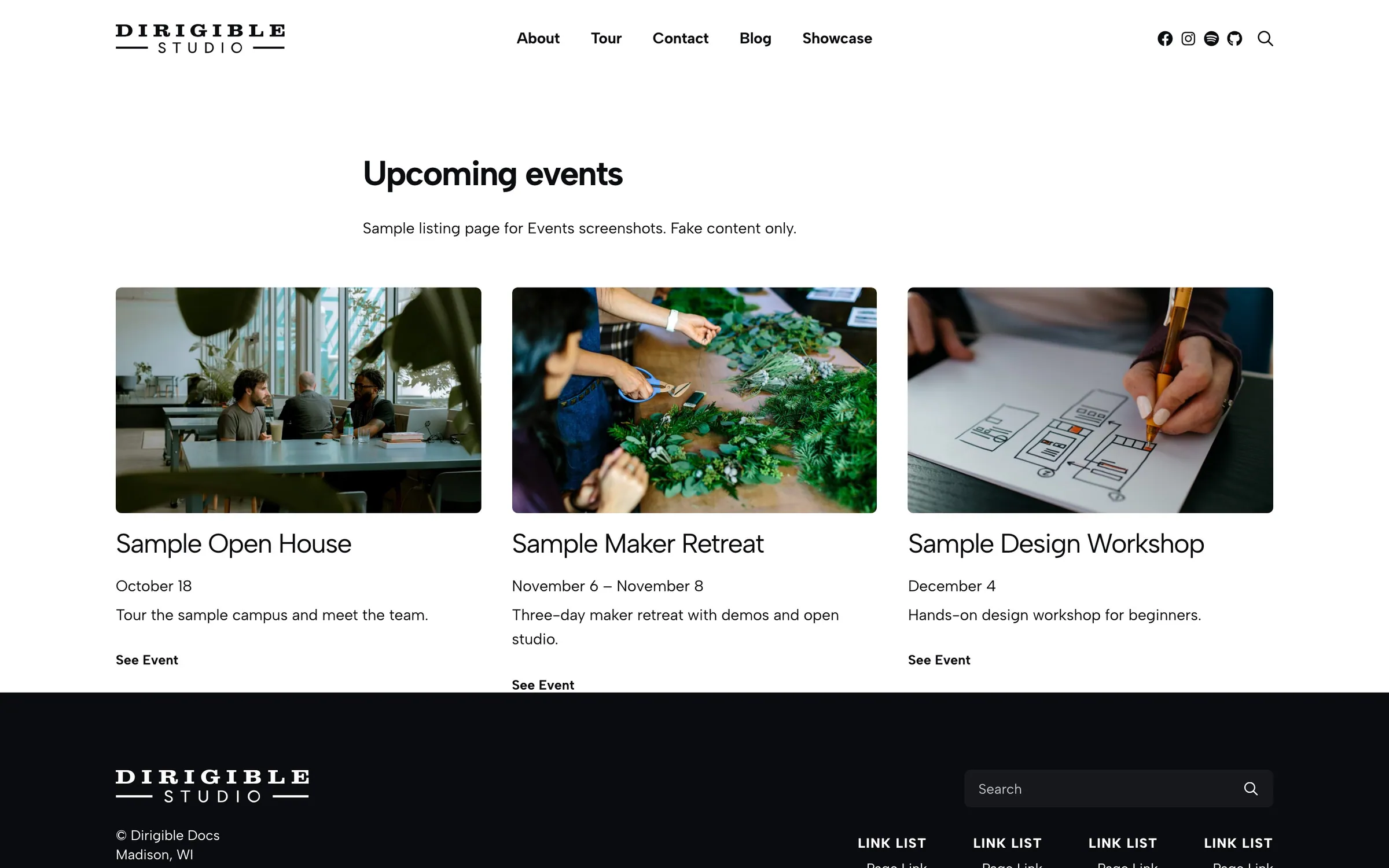
Overview
Everything under Events in the admin lives here. Each event has its own page built inside a Single Event block, a featured image, and sidebar fields for the date, venue, and details search engines read.
For step-by-step setup (creating events, adding listing blocks to a page, recurring series, and ticketing), start under Usage. This page is the reference for the event sidebar panels.
What visitors see
Each event gets its own URL (/events/{post-name}/ by default; change the slug in Events Global Settings). Listing blocks like Events link to these pages. A typical single event shows:
- Event title and formatted start (and optional end) time
- Venue and address (when enabled in Customizer)
- Optional excerpt, map embed, buy button or ticket link, and phone/email/website
- Freeform body content you build with blocks inside Single Event
See Hang Ten — Tarlton Theatre for a filled-out single event in production.
Editor basics
- Fields: title, block content, featured image, excerpt, and revisions
- No archive page: place Events or Events Calendar blocks on a page instead
- URL slug: Customizer Slug (default
events) - Starting layout: every new event opens with a Single Event block and a starter paragraph. Add any blocks inside it; the Single Event block itself can't be removed.
- Organizing: Categories (with parent/child levels) and Tags
Event Information (sidebar)
Core scheduling and venue fields:
- Starts — required date/time; drives all listing, calendar, and countdown behavior
- Ends — optional; multi-day events and "ongoing" detection use this field
- Location — pick a saved location when Dirigible Locations is active, or choose Custom to type the venue by hand. Linking a location hides the manual address fields.
- Website URL / Website Title — venue or external ticketing site
- Venue, Street Address, City, State, Zip, Phone, Email Address — manual venue details when Location is Custom
- Video URL — YouTube or Vimeo; the Events block can prefer video thumbnails over featured images
- Map Embed — paste a map embed iframe for the single-event layout
Recurring controls appear on the series parent only — see Usage → Recurring events.
Using the excerpt
Events listing blocks show the Excerpt on each card. Use it for short show details:
- Door time and showtime (
7:30pm // Appleton Beer Factory) - Lineup or bill order (
Hotline TNT, Disq, Cry Baby, Hang Ten) - Ticket or age restrictions
Event Meta (sidebar)
Details that help Google show your event in search results. The same fields appear in the Single Event block sidebar under Event Meta.
- Status — Scheduled (default), Cancelled, Postponed, Rescheduled, Moved Online
- Attendance Mode — Offline (default), Online, Mixed
- Organizer Name / Organizer URL — defaults to site name and URL when blank
- Performers — name and type (Music Group, Person, Group, Organization)
- Ticket Price, Ticket URL, Ticket Availability — for tickets sold elsewhere. These hide when Sell tickets for this event is on.
WooCommerce ticketing is covered in Usage → Ticketing.
Tips
- Always set Starts. Without it, events won't appear in listings or the calendar.
- Set Ends on festivals and multi-day conferences so they keep showing as ongoing.
- For tickets on Ticketmaster, Eventbrite, or similar, leave Sell tickets for this event off and use Ticket URL in Event Meta.
Screenshots
Editor
-
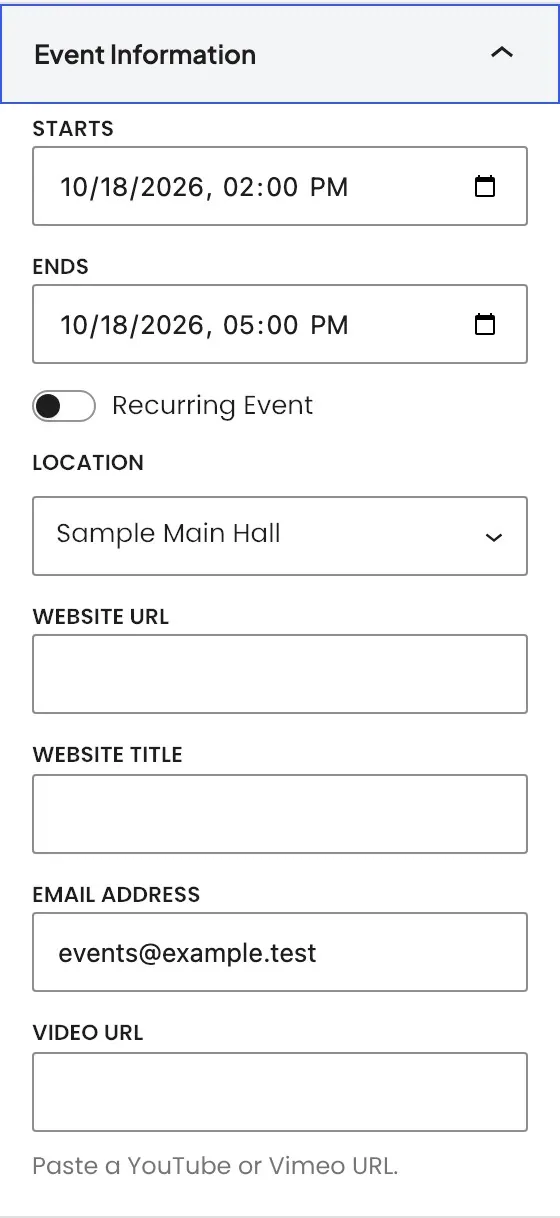
Event Information sidebar — Starts, venue, address, and contact fields.
Settings
Event Information

Required. Sets whether the event counts as upcoming or past, where it lands on the calendar, and what countdowns count to.
Optional. Use for multi-day festivals, exhibitions, or anything that runs past one day.
Creates a dated copy of this event for each repeat. Only appears on the first event in a series, not on the copies.
- DailyCreates an occurrence every day until Repeat Ends.
- WeeklyCreates an occurrence every week on the same weekday as Starts.
- Bi-WeeklyCreates an occurrence every two weeks.
- MonthlyCreates an occurrence on the same day of each month.
- YearlyCreates an occurrence on the same date each year.
The last date the series should create an occurrence.
Pick a saved location to fill in the venue and address for you. Choose Custom to type them on this event instead.
- CustomType the venue and address on this event.
Event or venue website. Shown on the event page when Show Website is on.
Link text for Website URL. Shown when Show Website is on.
Venue or room name, like "Tarlton Theatre." Hidden when a location is linked.
Only used when no location is linked.
Shown on the event page and in listing blocks when the address is turned on.
Usually shown with the city in listing blocks and the event header.
Listing blocks show it when Show Zip is on.
Shown on the event page when Show Phone is on.
Paste a map embed code from Google Maps or similar to show a map on the event page. If you link a location, that location's map is used instead.
Shown on the event page when Show Email is on in Events Single Template settings.
A YouTube or Vimeo link. Events blocks can use its thumbnail as the event image.
Ticketing
Sells tickets for this event through WooCommerce. Requires WooCommerce and Enable Ticketing under Dirigible Events → Ticketing in the Customizer.
In the Ticketing panel, this is the price on the buy button. In Event Meta, it's the price search engines see for tickets sold elsewhere.
Leave empty to use the default label, which includes the price.
Maximum tickets for this event. With ticket types, this is the shared venue total. Leave empty for unlimited.
Shows how many tickets are left under the buy button.
Event Meta
Tells search engines when an event is cancelled, postponed, rescheduled, or moved online.
Tells search engines whether the event is in person, online, or both.
- OfflineIn-person event.
- OnlineVirtual / online only.
- MixedBoth in-person and online.
Shown to search engines as the organizer. Leave blank to use your site name.
Leave blank to use your site URL.
In the Ticketing panel, this is the price on the buy button. In Event Meta, it's the price search engines see for tickets sold elsewhere.
Link to tickets sold on another site. Shown on the event page.
Tells search engines whether tickets sold elsewhere are in stock, sold out, or on pre-sale. Hidden when Sell tickets for this event is on.