

Structured Data for Search Engines
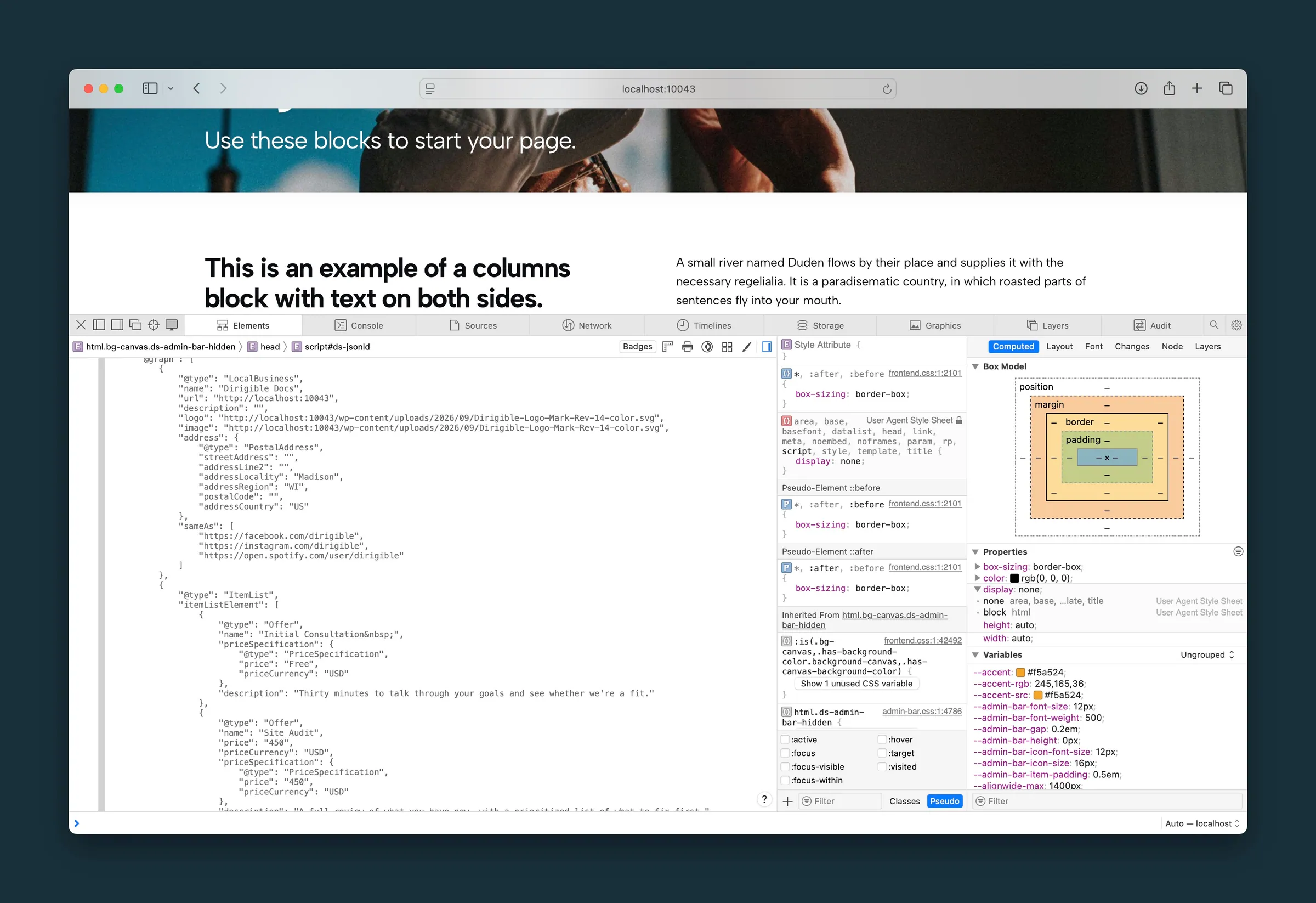
What it helps you do
Tell search engines about your business and content (contact details, blog posts, FAQs, breadcrumbs, and more) so they can show richer search results. Dirigible adds this structured data (schema markup) for you.
Where to find it
Structured data is added to your pages automatically. It comes from settings you already fill in:
- Settings → General in the WordPress admin: your Site Title and Tagline become the business name and description.
- Appearance → Customize → Footer & Contact → Contact Information: address, phone, and email.
- Appearance → Customize → Settings → Social Media: your social profiles, linked to your business.
- Appearance → Customize → Header & Menus → Logo: your logo.
- Block editor: FAQ, Breadcrumbs, Price List, Yearbook, and other Dirigible blocks add their own details.
- Dirigible SEO plugin (when installed): page-level SEO titles and meta descriptions. It works alongside the theme's structured data without repeating it.
How to use it
- Fill in Contact Information and Social Media so your business details are accurate.
- Publish blog posts with titles, excerpts, featured images, and authors. Each post is marked up as an article automatically.
- Use the FAQ block for questions and answers. They can qualify for FAQ results in Google, though Google decides what to show.
- Add Breadcrumbs to inner pages to show visitors and search engines where the page sits on your site.
- Install Dirigible SEO when you need per-page titles, meta descriptions, and social sharing previews.
To see what search engines get, run a page through Google’s Rich Results Test.
What happens automatically
- Every public page can include structured data, combining your site-wide business details with details about that page.
- Your business details (site title, tagline, logo, address, phone, email, and social profiles) are shared as a local business.
- Single blog posts are marked as blog articles with the author, dates, and featured image when available.
- FAQ blocks are shared as an FAQ. Several FAQ blocks on one page combine into one.
- Breadcrumbs, price lists, and yearbook blocks add their own details when they're on the page.
- The data refreshes when you update a post or publish Customizer changes. Pages that show details from other content refresh too, without being re-saved: a renamed category or author, an edited FAQ answer, a parent page's new title, or an event's updated location reaches every page that uses it.
Things to know
- Structured data helps search engines understand your site. It doesn't guarantee rich results or better rankings.
- Only FAQ blocks count as FAQs. Accordions built from other blocks aren't included.
- Keep your contact details current. An outdated phone number or address is shared with search engines too.
- Your host caches whole pages. When you change something that other pages show (an FAQ answer, an author, a location), those other pages can keep the old details until their cache clears. Purge the site cache if you need the change to show right away.
- Dirigible SEO handles titles, meta descriptions, and the editor SEO panel. The theme still provides the structured data.